![KG logo Signature-1.png]](https://kb.keywaste.ie/hs-fs/hubfs/KG%20logo%20Signature-1.png?height=40&name=KG%20logo%20Signature-1.png)
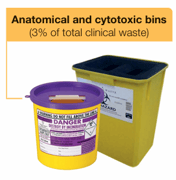
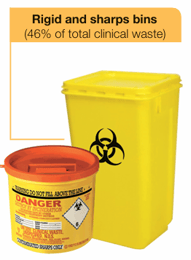
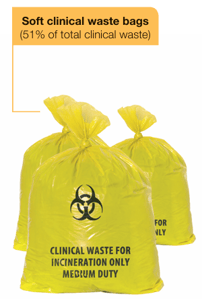
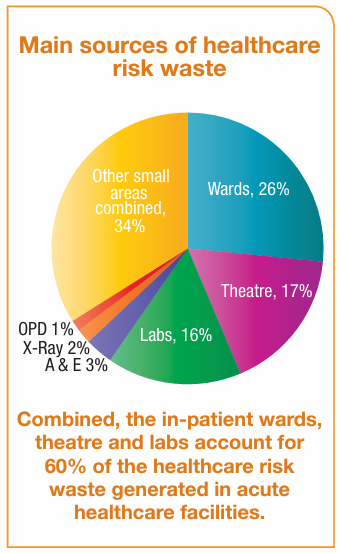
This factsheet provides an outline of the healthcare risk waste generated in Irish acute hospitals - where healthcare risk waste is generated, what is in healthcare risk waste, and what savings can be made through better management of healthcare risk waste. The information within this factsheet is based on the results of waste surveys carried out in over 50% of acute hospitals in Ireland.
What materials should be disposed of as healthcare risk waste?
- Items contaminated with blood
- Items contaminated with body fluids other than faeces, urine or breast milk, e.g. pus, sputum or perinatal fluid
- Contaminated waste from patients with transmissible infectious diseases
- Incontinence wear - only from patients with known enteric pathogens e.g. salmonella, rotovirus
- Other healthcare infectious waste from treatment areas as covered by definition of infectious waste
(Department of Health Guidelines)
Nationally, savings of between €800,000 and €1,300,000 per annum could be made in acute
hospitals, by ensuring that only healthcare risk waste is put into the healthcare risk waste stream.
Two types of healthcare risk waste is generated in Irish healthcare facilities:
- Regular healthcare risk waste (soft yellow bags, sharps & rigid bins) - sterilised and disposed of in Ireland (2010: 9,171 tonnes)
- Cytotoxic and anatomical healthcare risk waste (sharps bins & rigid bins) - sent for incineration abroad (2010: 712 tonnes)
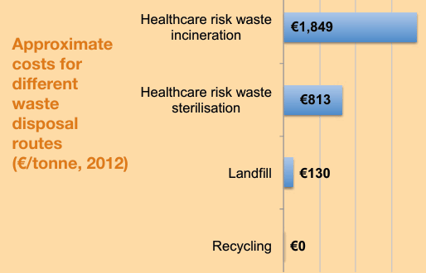
How much does it cost to incorrectly dispose of non-risk waste in the healthcare risk waste stream?
Putting non-risk waste incorrectly into the healthcare risk waste stream can cost your facility a lot of money! The graph below shows that it costs nearly €700 more per tonne to dispose of waste as healthcare risk waste, rather than as landfill waste. It costs over €1,000 more to dispose of waste as special healthcare risk waste.
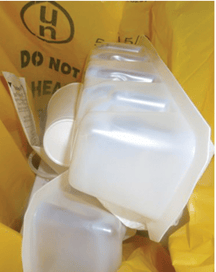
An example of clean composite packaging in a clinical risk waste bin:
What is in soft healthcare risk waste bags?
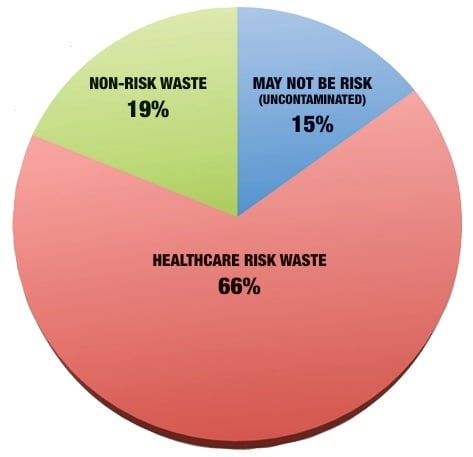
As part of the Green Healthcare Programm, healthcare risk waste bags from over 50% of national acute facilities were surveyed to determine their contents. The contents were grouped into three categories:
- Non-risk waste: non-clinical material, which is clean and not contaminated with blood or bodily fluid, e.g. cardboard, plastic packaging, magazines, paper, etc.*
- May not be risk (uncontaminated): clinical material which may not, in fact, be risk waste as it is clean/uncontaminated, e.g. clean table covers, clean
gowns, unused medical materials, etc.* - Healthcare risk waste: All other contaminated waste.
* While some materials may be from isolation rooms, and thus classified as clinical risk waste, it is unlikely that this accounts for all of this average level of 19% across all bags surveyed. - Non-risk material may also be placed into the rigid healthcare risk waste bins. These bins could not be examined as part of the surveys, as they are sealed in the medical area, before
disposal.