![KG logo Signature-1.png]](https://kb.keywaste.ie/hs-fs/hubfs/KG%20logo%20Signature-1.png?height=40&name=KG%20logo%20Signature-1.png)
Ensuring that your healthcare facility provides the right type of bin, in the right location, is essential to reduce the quantity of waste being incorrectly managed. Systematically looking at the number, type and location of bins in your facility, area by area, can help identify improvements. This Best Practice Guide outlines measures which should be observed in the provision of waste bins.
Are the correct types of bins provided?
Talk to relevant staff in the area and determine the type and quantity of waste that is normally generated in the area. Only provide a waste bin if that waste is generated. Try not to consider ‘just in case’ scenarios. For example, don’t provide a healthcare risk waste (HCRW) bin, if healthcare risk waste only needs to be disposed of occasionally.
If there is the possibility of reasonable quantities of recyclable materials being generated, consider providing a recycling bin.
Is the right number of bins provided?
Is more than one of each type of bin, particularly landfill bins provided? This may be the case in large rooms. Waste bins are regularly emptied, usually once a day or more, so consider if one bin is enough? Multiple bins require cleaning staff to spend more time emptying bins, lining bins
with bags and cleaning bins.
Provide the right sized bin
If only small quantities of healthcare risk waste and general landfill waste are generated, then it may be sufficient to provide a small bin. Bulky recyclable material cannot then be incorrectly placed in the general landfill bin or HCRW bin.
Place the bin in the right location
The general landfill waste and recycling bins should be placed as close to the main
area of waste generation as possible. This is to limit the distance that staff have
to travel with waste.
Use clear instructional signage
Staff are often willing to recycle, just like at home, but are unsure what can be recycled in a healthcare facility.
Signage should be used to highlight to staff what can and cannot be placed in each type of waste bin. All instructional signage should be simple and use pictures or symbols rather than words. People recognize pictures quicker than words; making it easier to recognise suitable materials. Pictures are also helpful to overcome language barriers with international staff.
All signage should be consistent across the different areas of the hospital, especially where staff move between different departments. All signage should be developed in line with infection control requirements.
Have a look at the sample signage, as shown here, on the Green Healthcare Programme website.
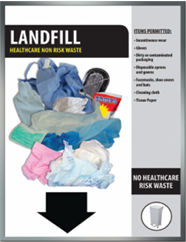

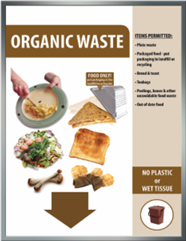
Focus on the position of the Healthcare Risk Waste (HCRW) bin
Specific observations apply to the position of the HCRW bin, as follows:
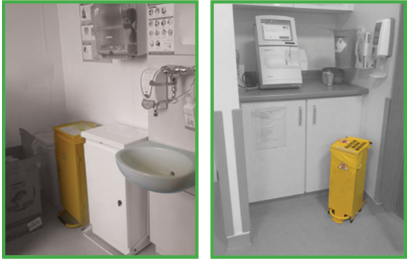 |
Good practice in provision of bins: HCRW bin positioned away from hand wash sink (left); small HCRW bin used in area with small level of healthcare risk waste generation (right). DO place the HCRW bin: Next to a general landfill waste or recycling bin. Staff have to make a decision on which bin to use. Make sure to place the general landfill or recycling bin closer to the main source of waste generation. |
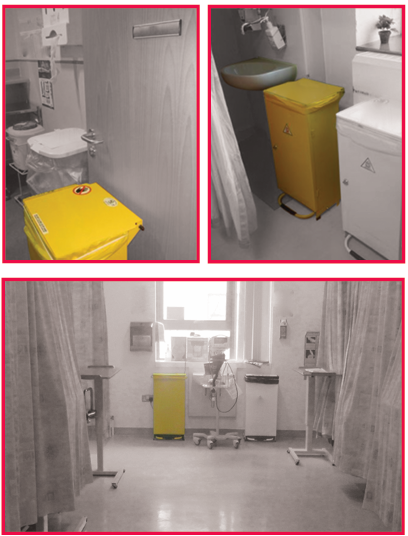 |
Bad practice in provision of bins: Clockwise from top left: HCRW bin used as a doorstop; HCRW bin nearest hand wash sink; HCRW bin in multi-bed public access ward. DO NOT place the HCRW bin: Next to a hand wash sink as paper towels are usually thrown into the nearest bin, whether it is the correct bin or not. Place a general landfill bin or recycling bin next to the sink instead. Near the entrance to a room, especially where the door is continually open - it may be used by someone in the corridor. This does not apply in an isolation room, where the bin is used for the collection of PPE (gloves, gowns, aprons, etc). For similar reasons do not use a HCRW bin as a door stop. If retained in publicly accessible areas e.g. multi bed rooms, do not place within easy access of patient beds. Patients and visitors will generally place waste into the nearest bin. |